5 min read
•
Technical
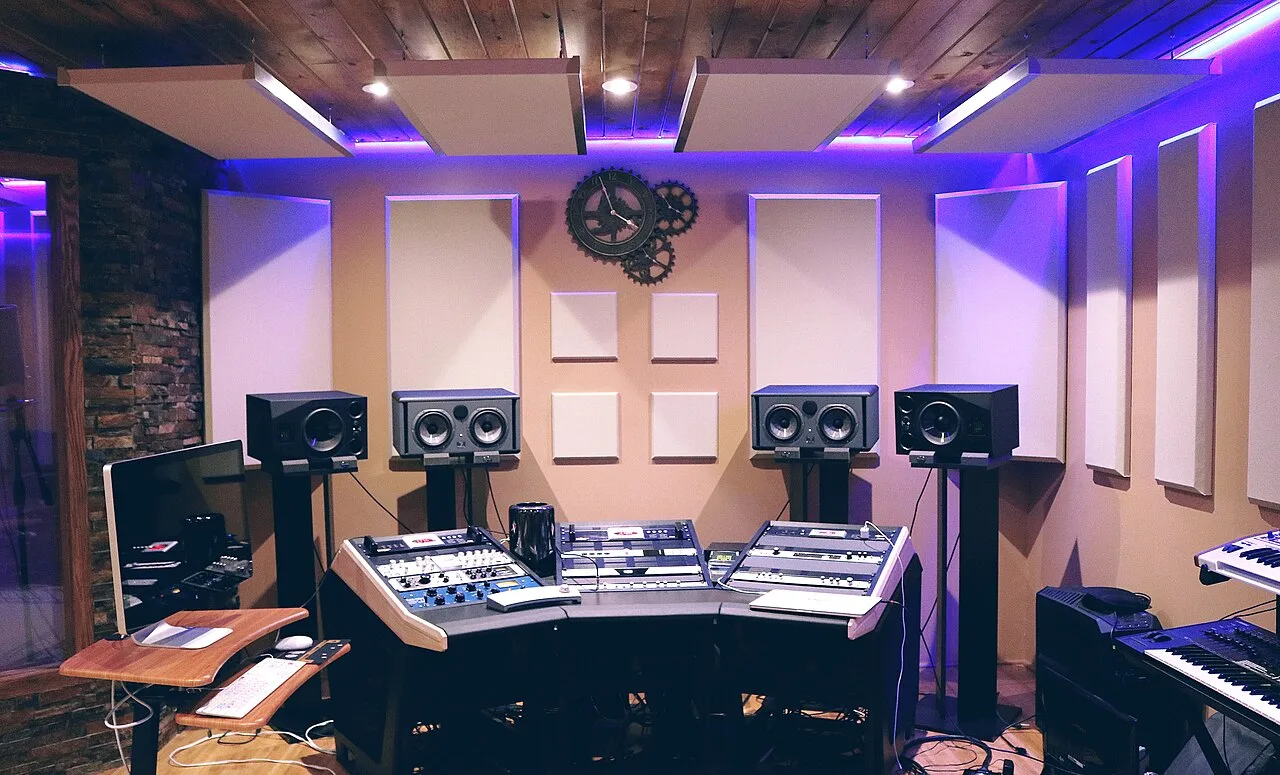
We pulled up to a mid-sized tracking room in East Nashville last Tuesday because the client was pulling his hair out over a muddy low end. Every kick drum below 120Hz vanished the moment he sat in the mixing chair. The monitors were resting on foam wedges against the drywall, pushed into the corners like living room bookshelf speakers. Big mistake.
- ✓ The Equilateral Triangle Fallacy
- ✓ Comb Filtering and the Speaker Boundary Interference Response
- ✓ Tweeter Height and Vertical Axis Alignment
- ✓ De-Cluttering the Mixing Console Reflection Plane
Physics does not care about your acoustic foam budget or your monitor’s frequency response chart. If you ignore boundary interference, phase cancellation, and room geometry, your expensive monitors are nothing more than expensive noise generators. Let us look at the raw data and fix your room.
- The 38% rule for listening position is a baseline, but boundary interference response (SBIR) dictates your true low-frequency reality.
- Tweeters must sit at exact ear height, measured with a laser or tape measure—not eyeballed.
- Console reflections smear your stereo image; fix early reflection points before buying room correction DSP.
The Equilateral Triangle Fallacy
Everyone reads the manual: ‘Form a 60-degree triangle with your monitors.’ True, but useless if you place that triangle in the dead center of a square room. Standing waves will destroy your transient response. At 104 dB SPL peak output, a poorly positioned set of 8-inch active monitors will excite every room mode from 40Hz to 120Hz.
Here is the cold math. Measure your room’s length. Multiply by 0.38. That is your listening position from the front wall. Why? Because sitting at 38% of the room length places you in a pressure node null zone that smooths out axial room modes. Not quite a cure-all, but it beats guessing every single time.
Comb Filtering and the Speaker Boundary Interference Response
Let us talk about SBIR. When sound leaves your woofer, it travels forward to your ears, but it also travels backward to the front wall, bounces off, and arrives at your ear a few milliseconds later. That delayed wave sums with the direct wave, creating comb filtering—deep notches in your frequency response.
If your woofer is 2 feet from the front wall, the quarter-wavelength cancellation hits right around 140Hz. That is right where your snare body and guitar fundamentals live. You boost 140Hz on the EQ, wonder why it sounds thin outside the studio, and ruin your mix.
The Two Placement Solutions:
- Flush Mount: Push the cabinets dead against the front wall (0 inches). This pushes the SBIR cancellation up past 500Hz, which you can easily treat with 4-inch rigid fiberglass panels.
- The Standby Gap: Pull the monitors at least 3.5 feet away from the front wall. This pushes the cancellation down below 30Hz, safely outside critical musical frequency ranges.
🎵 Studio Acoustics & Streaming Royalty Calculation Matrix
Use these standardized metrics when auditing your acoustic setup or calculating downstream mix translation across streaming platforms paying $0.0038/stream.
| Parameter | Target Value | Acoustic Impact |
|---|---|---|
| Monitor Angle | 60 Degrees | Accurate phantom center and transient localization |
| THD+N Floor | < 0.0004% | Zero coloration from internal power amp stages |
| Sample Rate / Bit Depth | 24-bit / 96kHz | Transparent DSP plugin modeling and phase fidelity |
| SPL Calibration | 83 dB C-Weighted | Optimal ear sensitivity curve (Fletcher-Munson) |
Tweeter Height and Vertical Axis Alignment
Most project studios have monitors sitting on meter bridges angled downward at the mixing engineer’s chest. Big mistake. You are mixing high-frequency content off-axis. High frequencies beam aggressively.
Get heavy, mass-loaded speaker stands independent of your desk. Adjust the height so the acoustic center—the point directly between the tweeter and the woofer—is level with your ears. If your monitors have asymmetrical waveguides, check the manual. Some are meant to be placed horizontally, but 90% of studio monitors lose their horizontal dispersion pattern when laid on their side.
De-Cluttering the Mixing Console Reflection Plane
You bought great monitors, aligned the 60-degree triangle, and your desk is a massive wooden mixing surface reflecting sound straight into your chin. That is early reflection smear. It destroys depth perception.
Tilt your mixing desk downward, move MIDI controllers off the primary reflection path, or drape a dense acoustic blanket over the console bridge during critical mixing passes. Until you stop the console bounce, your stereo imaging is a lie.
Frequently Asked Questions
What is the rule of thirds for speaker placement?
The rule of thirds places your listening position one-third of the way down the length of the room from the front wall. This specific coordinate avoids the most destructive axial room modes and evens out low-frequency response.
How far should studio monitors be from the front wall?
Monitors should either be less than 1 foot from the front wall to push SBIR cancellation frequencies high up into the spectrum where treatment works, or at least 3 to 4 feet away to push the cancellation notch below human hearing thresholds.
What is the ideal angle for mixing monitors?
Monitors must form a strict 60-degree equilateral triangle with your head. Tweeters must sit precisely at ear height, angled directly toward your ears with the acoustic axis intersecting just behind your head.
How do I calculate acoustic boundary interference response (SBIR)?
SBIR occurs when sound waves reflect off walls and cancel out direct sound at specific frequencies. The cancellation frequency is calculated using the speed of sound divided by four times the distance from the boundary.
